Why do bathtubs have feet?
Why do bathtubs have feet? And why an animal holding a ball? In this post an ancient Greek goatherder inspires a furniture maker, who inspires a painter, who in turn inspires another furniture maker thousands of years later to create fashion trend and a tidy profit by giving bathtubs animal feet and making them balance on a ball which was largely due to the f the new scientific discovery of germ theory by giving bathtubs animal feet balancing on a ball.Goats are everywhere
In ancient Greece goats were as common as end tables. End tables that get in your way. And stink. ...and then knock you down for no reason, stink a little bit, and then get in your way again for some more stinking. They did have some good things going for them, like food and clothing, but most important was their personalities. The goat's personality has such ancient cultural and religious sterotypes that we still reference them today, like calling a grumpy old man an Old Goat. Goats can be cantankerous but they can be mischievous with a sense of humor. A young goat is called a kid - and if you've ever been around a kid who's so full of energy they could burst you'll know why they named one kid after the other kid . The French called a two-wheeled horse-drawn carriage a "cabriolet", after the Old French word "cabrioler" which meant "the way goats leap and bounce" because the carriage would bounce around violently and unpredictably.Greeks and Nature
For the ancient Greeks, Reason was the highest expression of humanity. The ancient Greeks used their Math to describe and explain nature. One example of this is their fascination with function, e.g., the rear legs of ungulates - hoofed animals like cows, horses, gazelle, and of course, goats. With the ungulate leg being mathematically examined, explained, and described the artists used that knowledge to design and build a lightweight support that looks like a goat's rear leg that could take heavy loads and sharp impacts by distributing the stress loads.The Romans liked the Greeks
In Pompei and Herculaneum the charred remains of these "goat legs" on tables and chairs have been recovered. Frescoes with incredible "goat-legged" wooden tables almost look out of place to our modern eyes; they look just like modern tables. Everything else in a Roman fresco looks ancient except those AI deep fake tables with their modern legs. The Romans who made those frescoes thought so too. It was a very modern - a revival of the Classical Greek form with a modern Roman twist .The Renaissance looks back to look forward
Almost a thousand years later in 15 century Europe the Renaissance was beginning with a rediscovering of the Classical Greek and Roman world. The styles developed and perfected in Italy swept into Paris and the Loire Valley with Catherine de' Medici's entourage of craftsmen brought to the court of her husband, the future King Henri II of France. These new designs quickly supplanted the last remnants of Gothic style among the furniture makers of Northern France. At this time the French furniture makers named the "goat-leg" design "cabrioler"...meaning, to leap like a goat.Industrial Revolution and health
Around this time (1760) the Industrial Revolution was gearing up and the indoor plumbing industry had just begun. In 1728 the first underground sewer was installed in New York, and in 1830 the first public water main was installed there as well. To follow was the invention of drainage pipes to take sewage away from buildings to a disposal terminal. In 1848 the United States Congress passed the National Public Health Act which gave all communities access to water mains and drainage pipes which resulted in a huge decrease in diseases and ranked the United States as the top leaders in modern plumbing. Germ theory won't occur to Pasteur until 1850 and John Snow's findings in 1854 that cholera could be spread by contaminated water would still take some years to be accepted, but his work led to fundamental changes in the design of public water and waste systems.Mass production equals choice
Bathtubs in the home were a luxury...especially when you consider that plumbing had to be introduced to homes that were already built. No building codes existed yet, and hardware, like connectors and straps, were being figured out as they went along, so many were custom designs for those luxury tastes. Pursuing hygiene was more a class and fashion statement then a norm and the bathtub was treated as a piece of furniture. Well, that just demands the latest styles - time to go shopping. And what a shopping trip it was, too. Cast iron radiators, stoves, sinks, bathtubs, tables, and more could all have different design options for remote purchase and shipping. A bathtub's body could be mass produced and shipped and stored in various plumbing warehouses around the world. If the customer wants special feet that are not in stock the body can still be purchased and installation could begin while the specialty bathtub feet are being shipped separately. All styles of feet could be chosen, from fancy Rococo to modern Neo-classical and Empire. The Chippendale foot was a comfortable style that appealed to many people and has become typified by the American Standard Sanitation Company's classic model. The simple and graceful lines of Queen Anne (1720-1780) used the same cabriole leg as the flamboyant and intricate styles of Rococo (1723-1760) and Chipendale (1755 - 1790) all of which made use of weighty lion and eagle claw's holding a ball.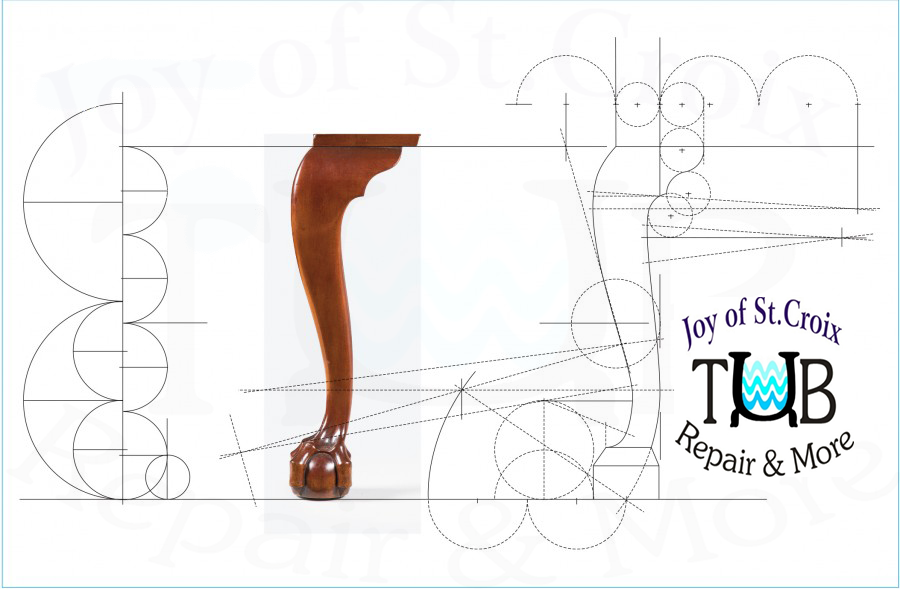
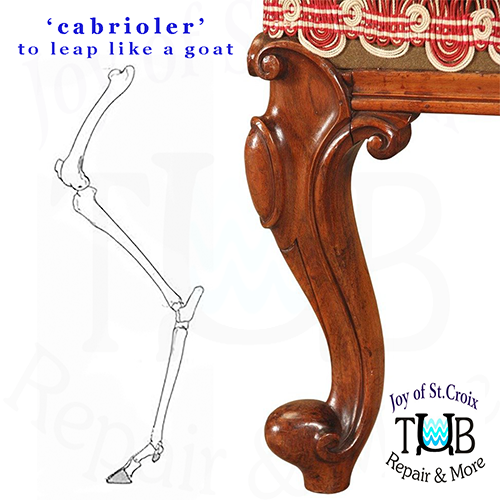
The cabriole leg
A cabriole leg is one of (usually) four vertical supports of a piece of furniture shaped in two curves; the upper arc is convex and always bows outward, while lower is concave and bows inward. The cabriole leg style is found in the frescoes of Ancient Greece and the paintings of Ancient China. The design is inspired by the rear leg of hoofed animals. The etymology of this term specifically derives from the French word cabrioler, meaning to leap like a goat.Identify the Style
The graceful curves of a cabriole leg are easy to love. What's decidedly more difficult is identifying the many styles within this broad genre of design. While all interpretations share a signature shape composed of two gently opposing arches, each style retains some signature element that makes the cabriole all its own. Follow some designer tips to readily identify four of the most popular variations of this timeless furniture classic. Queen Anne Style: Queen Anne cabriole legs commonly have a thinner ankle and a simple, pad-style foot. While occasionally seen without any embellishment, traditional shell motifs are typically found at the top of Queen Anne cabriole legs.Chippendale Style: The Chippendale is most often identifiable through the appearance of heavy, substantial proportions and a large, prominent weighty ball-and-claw foot.
Louis XV Style: The Louis XV style of cabriole leg is identifiable by intricate carvings and detail, a shorter leg, and with the opposing curves nearly identical in proportion. The foot of Louis XV cabriole legs traditionally ends with an elaborate drake foot on a small bun.
Colonial Style: Most closely related to Queen Anne style, Colonial cabriole legs are thin and delicate in proportion. Usually free from embellishments or carvings, the long graceful legs typically conclude in a tapered slipper foot, giving the leg a sleek profile.